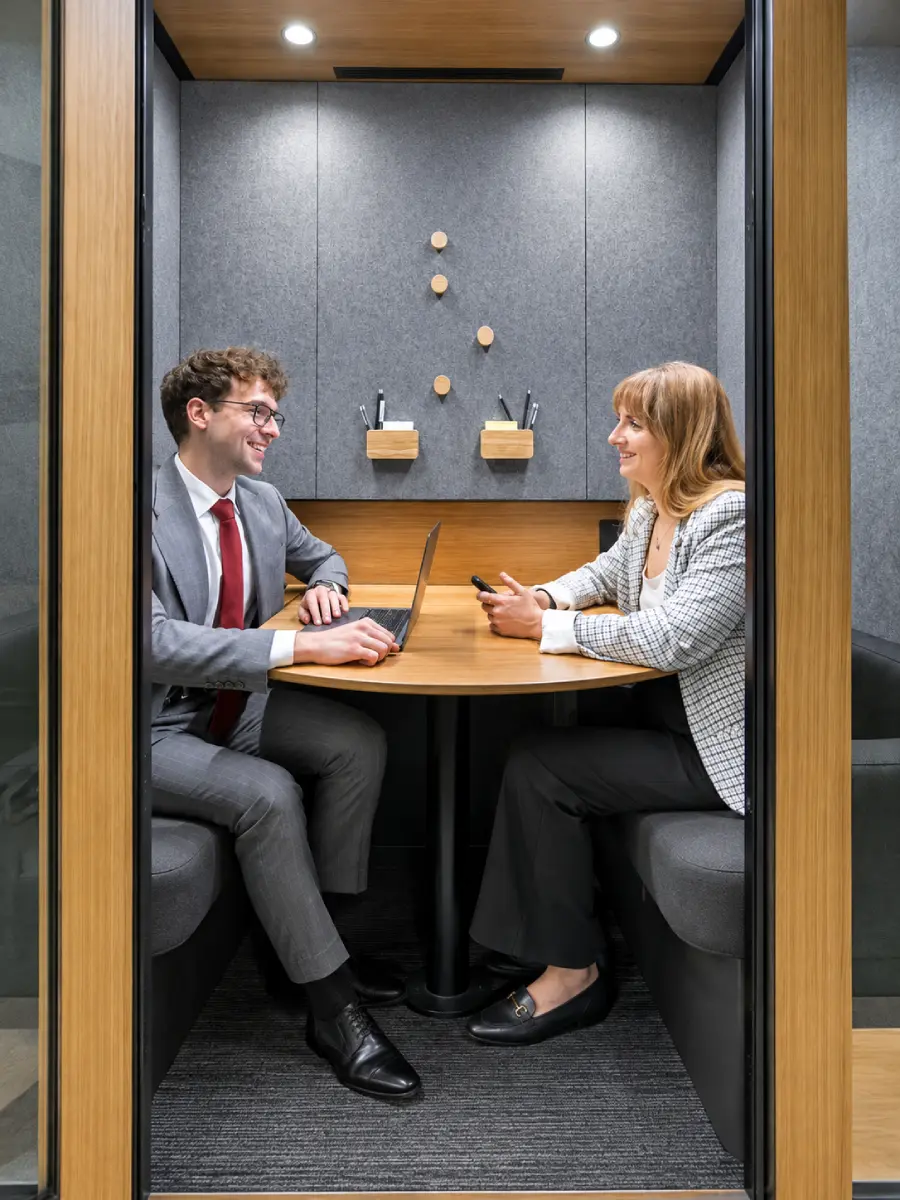


A noisy office can have different causes. In some workplaces, hard surfaces create echo and reverberation. In others, conversations travel too easily, or there simply are not enough private spaces for calls and meetings.
Glass conference rooms, acoustic panels, and office pods address these problems in different ways. The right choice depends on whether your priority is controlling reflected sound, improving speech privacy, or adding enclosed meeting space.
Start With the Acoustic Problem, Not the Product
Before choosing between acoustic panels, a conference room, or a pod, it is important to identify what employees are experiencing during the workday. Most office acoustic problems fall into three broad categories:
- excessive echo and reverberation;
- lack of speech privacy;
- insufficient enclosed space for calls and meetings.
Each problem requires a different approach. A solution designed to absorb reflected sound will not automatically create privacy, while an enclosed room may solve privacy issues without improving the acoustics of the wider office.
Too Much Echo and Reverberation
Hard materials such as glass, concrete, drywall, hard flooring, and exposed ceilings reflect sound instead of absorbing it. As a result, voices and other sounds remain in the room longer and overlap with new sounds. Once several conversations are happening at the same time, the office can quickly become difficult to work in.
Typical signs include:
- noticeable echo;
- poor speech clarity;
- voices sounding louder than expected;
- difficulty understanding people during meetings;
- increasing background noise as more employees begin speaking.
This is primarily an acoustic treatment problem. Adding materials that absorb reflected sound can reduce reverberation and make the room feel calmer without fundamentally changing the office layout.
Conversations Can Be Heard Too Easily
A different problem occurs when an office has acceptable room acoustics but very little privacy. Employees may be able to clearly understand conversations taking place nearby even if the space itself does not sound particularly loud or echoey.
This becomes especially important during:
- HR discussions;
- job interviews;
- client calls;
- financial conversations;
- management meetings;
- one-on-one conversations;
- discussions involving confidential information.
In these situations, reducing reverberation alone is not enough. The office also needs to address speech privacy – the ability to keep conversations from remaining intelligible outside the area where they take place.
There Are Not Enough Private Rooms
Sometimes the problem is not primarily acoustic at all. The office simply lacks enough enclosed spaces.
A large conference room may repeatedly be occupied by one employee joining a video call because no smaller private space is available. Two colleagues who need a confidential conversation may have nowhere to go, while other calls take place directly at open-plan desks and create distractions for everyone nearby.
This is a space-planning problem with an acoustic component. In this situation, the company may need additional enclosed rooms or pods rather than more acoustic treatment on existing walls and ceilings.
Glass Conference Rooms: A Permanent Solution for Meetings
Glass conference rooms are common in modern offices because they create physical separation while preserving visual openness and access to natural light. They can be a practical solution when an organization needs a permanent meeting space and expects the office layout to remain relatively stable.
A built-in glass room may be appropriate when:
- meetings regularly involve larger groups;
- the office has enough floor space for a permanent room;
- the company has a long-term lease or owns the premises;
- visual openness is important to the interior design;
- construction is already part of a larger office renovation.
For larger team meetings, presentations, and discussions that require more floor area, a conventional conference room can still be more practical than several small enclosed spaces.
The Acoustic Challenge of Glass
The main limitation is that glass itself does not guarantee good acoustic performance. Doors, seals, framing, wall-to-ceiling connections, ventilation openings, and the surrounding construction all affect how much sound enters or leaves the room.
Glass is also highly reflective. A meeting room surrounded by hard surfaces may look modern but still produce noticeable reverberation, which can reduce speech clarity and make both in-person and video conversations more tiring.
For this reason, a well-designed glass conference room often requires two different acoustic strategies:
- sound isolation to reduce transmission between spaces;
- sound absorption to control reflections inside the room.
Both matter. Good isolation without sufficient absorption can still leave the room sounding harsh, while good absorption alone does not prevent conversations from travelling outside the room.
Acoustic Panels: Best for Managing Reverberation
Acoustic panels serve a different purpose. Instead of creating another room, they absorb sound that would otherwise reflect from walls or ceilings. This can be particularly useful in offices with large amounts of glass, concrete, drywall, or other hard materials.
They are commonly used in:
- open-plan offices;
- existing meeting rooms;
- collaboration zones;
- reception areas;
- cafeterias and common spaces;
- offices with exposed ceilings.
Their main purpose is to reduce reverberation and improve the acoustic quality of the environment that already exists.
What Acoustic Panels Can Improve
Imagine an office where every conversation seems to spread across the floor. Part of the problem may be the number of people speaking, but another part may be the way sound repeatedly reflects between hard surfaces.
By introducing absorptive materials, the office can reduce these reflections and make the environment feel less acoustically active. Speech may become easier to understand, meeting rooms can sound clearer, and the general noise level may feel more manageable even though the number of people in the space has not changed.
Acoustic panels are especially useful when employees describe problems such as:
- “The room echoes.”
- “Everything sounds too loud.”
- “It becomes difficult to understand people when several conversations happen at once.”
These complaints usually indicate that reverberation is an important part of the problem.
What Acoustic Panels Cannot Replace
Acoustic panels do not create a private room. They absorb reflected sound, but they do not surround a conversation with a complete enclosure.
If an employee needs to conduct a confidential interview or discuss sensitive information, panels alone will not provide the same function as an enclosed meeting space. This does not make acoustic panels ineffective – it simply means they are designed to solve a different problem.
They are primarily an acoustic treatment tool rather than a substitute for a conference room, meeting pod, or private booth.
Soundproof Office Pods: Flexible Space for Privacy
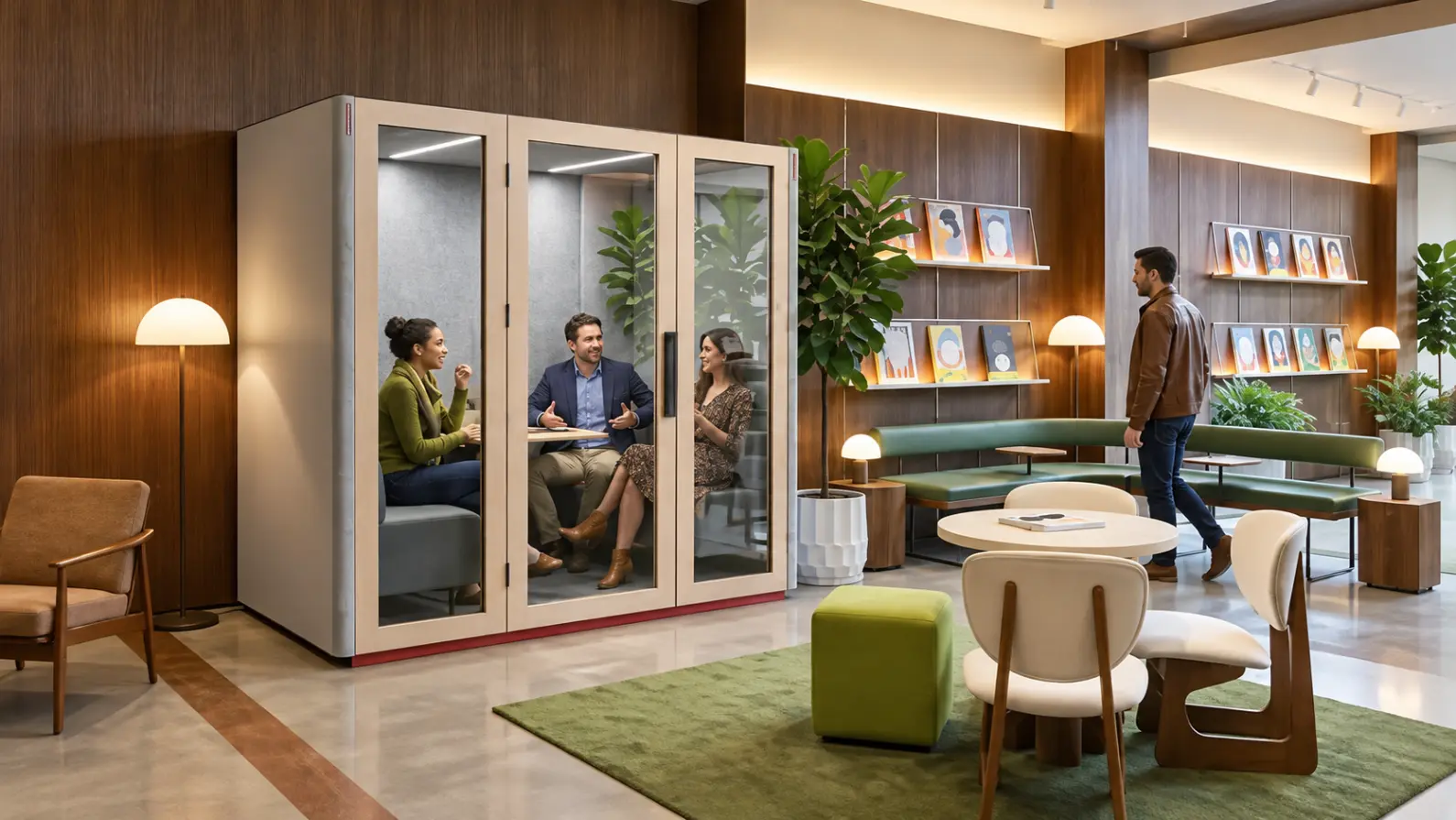
Office pods address both space availability and speech privacy. A soundproof office pod creates an enclosed workspace within the existing office without requiring the company to build another permanent room.
This makes pods particularly useful when employees regularly need private spaces for:
- calls;
- video meetings;
- interviews;
- focused individual work;
- one-on-one conversations;
- small meetings;
- discussions involving sensitive information.
Instead of redesigning the entire floor plan, companies can add enclosed spaces where demand actually exists.
Flexibility Is the Main Difference
A permanent conference room becomes part of the building, while a modular pod does not have to. That distinction can be important in leased offices or in companies where team size and workspace requirements may change over time.
Pods can be particularly useful for:
- growing companies;
- hybrid workplaces;
- leased offices;
- businesses expecting future relocation;
- offices where meeting demand changes over time.
This does not mean pods should replace every conventional conference room. In many offices, their role is to fill the gap between an open workstation and a large meeting room by creating smaller enclosed spaces for activities that do not require a full-size conference room.
Different Pod Sizes Solve Different Problems
One reason large meeting rooms are often overbooked is simple: employees use whatever enclosed space is available. A room designed for ten people may be occupied by one person joining a short video call simply because there is no smaller private option.
Providing different sizes of enclosed spaces allows companies to match the room more closely to the activity taking place inside it. This can improve both privacy and the overall efficiency of the office.
Individual Calls and Focused Work
A one person office pod can provide dedicated space for individual calls, video meetings, and tasks that require fewer distractions. Instead of occupying a larger conference room, one employee can use a space designed specifically for individual work.
This can also reduce the number of calls taking place at open-plan desks and help keep larger rooms available for group meetings.
Interviews and One-on-One Meetings
Some conversations require two people but do not justify reserving a full conference room. Interviews, private discussions, negotiations, and regular one-on-one meetings are typical examples.
A two person meeting pod provides a separate environment for these conversations while allowing larger conference rooms to remain available for activities that actually require more space.
Small Team Meetings
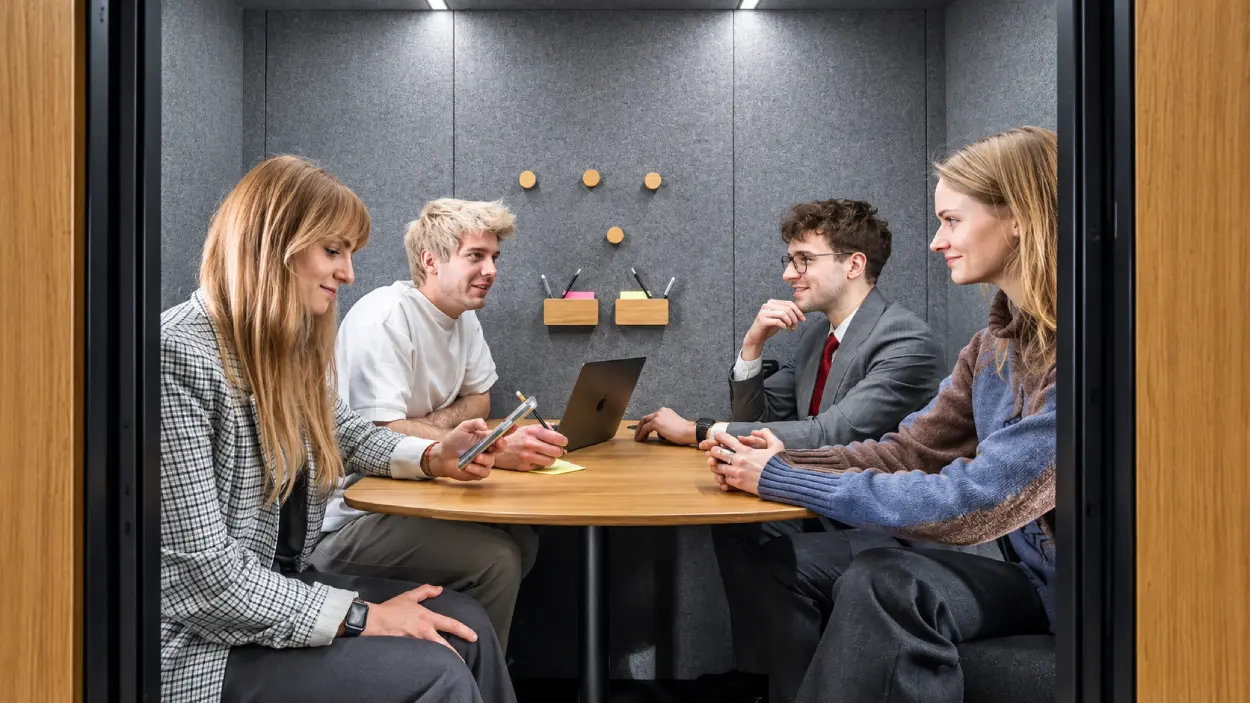
Small project teams often face the same problem. A meeting involving three or four people may need privacy and separation from the surrounding office, but using a large boardroom can be inefficient.
A 4 person office pod can provide an enclosed space for:
- small team meetings;
- project discussions;
- collaborative work;
- meetings where reduced distraction is important.
Matching room capacity to actual meeting behaviour can help organizations use available floor space more effectively.
Glass Rooms vs. Acoustic Panels vs. Pods: What Actually Changes?
Rather than asking which product is universally better, it is more useful to compare each option according to the problem it is designed to solve.
| Office Requirement | Acoustic Panels | Glass Conference Room | Office Pod |
|---|---|---|---|
| Reduce echo and reverberation | Excellent | May require additional acoustic treatment | Acoustic treatment is built into the enclosed space |
| Create an enclosed meeting area | No | Yes | Yes |
| Improve speech privacy | Limited | Depends on construction | Designed for private conversations |
| Support confidential calls | No | Possible with appropriate construction | Yes |
| Add space without major construction | Yes | No | Yes |
| Adapt to changing office layouts | Limited | Limited | High |
| Accommodate larger meetings | No | Yes | Depends on pod size |
| Provide space for individual calls | No | Possible, but often inefficient | Yes |
| Preserve an open visual environment | Yes | Yes | Depends on placement |
| Improve general office acoustics | Yes | Limited to treated areas | Primarily improves conditions inside the pod |
The comparison highlights an important point – these solutions should not always be treated as direct competitors. In many offices, they solve different layers of the same workplace problem.
When One Acoustic Solution Is Not Enough
Modern offices rarely have only one type of acoustic issue. An open-plan workspace may have excessive reverberation across the main floor while also lacking private rooms for calls. A conference room may provide good physical separation from the rest of the office but still sound uncomfortable inside because of reflective surfaces.
In situations like these, combining several solutions can be more effective than expecting one product to solve every problem.
Acoustic Panels and Office Pods
This combination can work particularly well in open-plan offices. Panels reduce reflected sound across the shared workspace, while pods provide enclosed areas for employees who need privacy, focused work, or separation from surrounding activity.
In practical terms:
- panels improve the general acoustic environment;
- pods create dedicated private environments;
- each solution handles a different part of the problem.
This makes the combination especially useful when the office has both reverberation and privacy issues.
Glass Conference Rooms and Acoustic Treatment
An existing glass conference room does not necessarily need to be replaced simply because the acoustics inside it are poor. If excessive reverberation is the main issue, the room may benefit from additional absorption instead.
Possible treatments include:
- wall-mounted acoustic panels;
- ceiling treatments;
- absorptive furniture and finishes;
- other materials selected as part of the acoustic design.
This allows the company to retain the existing room while improving the quality of conversations inside it.
Existing Conference Rooms and Pods
Another effective strategy is to keep larger conference rooms and add smaller enclosed spaces elsewhere in the office. This creates a more balanced hierarchy of meeting spaces.
For example:
- individual calls can move into one-person spaces;
- private conversations can take place in two-person rooms or pods;
- small teams can use smaller enclosed meeting spaces;
- larger conference rooms remain available for presentations and group meetings.
The result is not necessarily more total meeting space – it is a better match between room size and actual use.
FAQ
1. Is the Main Problem Echo or Privacy?
This is the first distinction to make. If employees complain about echo, poor speech clarity, or excessive reverberation, acoustic absorption may be the priority. If the concern is that conversations can be clearly overheard, the office needs to address speech privacy instead.
These problems can exist at the same time, but they require different solutions.
2. How Many People Need Space?
Meeting-room usage should be evaluated based on real behaviour. If most bookings involve only one or two employees, adding smaller enclosed spaces may be more efficient than building another large conference room.
If the company regularly hosts larger team meetings, presentations, or client sessions, a conventional conference room may remain essential.
3. Does the Layout Need to Stay Flexible?
Permanent construction works best when the organization expects the office layout to remain stable for a long period. That may not be the case for a growing business, a company working from leased premises, or a team using a hybrid model.
Before committing to a fixed room layout, consider:
- future team growth;
- departmental changes;
- relocation plans;
- changes in hybrid-work patterns;
- potential demand for additional private spaces.
These factors can influence whether permanent construction or a modular solution makes more sense.
4. How Important Is Speech Privacy?
Not every workplace conversation has the same privacy requirements. An informal brainstorming session and a confidential HR meeting are very different situations.
Companies should identify which activities need greater privacy and determine whether general acoustic treatment is enough or whether those conversations require a fully enclosed environment.
5. Are You Improving One Room or the Entire Office?
A single product should not be expected to solve every acoustic problem across a large workplace.
For example:
- a pod can create a private environment for calls but will not automatically reduce reverberation across an entire open office;
- acoustic panels can improve overall room acoustics but will not create additional meeting spaces;
- a glass room can provide a permanent meeting area but may still require acoustic treatment inside.
A successful strategy therefore looks at the office as a system rather than treating every acoustic issue separately.