

In an open office, staying focused can be difficult. Phone calls, meetings, and conversations create constant background noise. For comfortable work, the noise level in an office should typically not exceed 40–45 dB, while in open-plan environments it often reaches 55–65 dB. Even a moderate increase above these levels raises cognitive load and can reduce productivity.
Companies install acoustic panels, and employees look for “quiet corners,” yet the problem of privacy often remains.
The reason is frequently a misunderstanding between two different concepts: sound absorption and sound insulation. These solutions work on different principles and deliver different results.
Let’s look at the differences — and why many open-plan offices are increasingly turning to a third approach: acoustic office pods.
What Is Sound Absorption?
To choose the right solution, it’s important to understand how sound behaves inside an office space and why some methods improve acoustic comfort but do not necessarily provide privacy.
How It Works
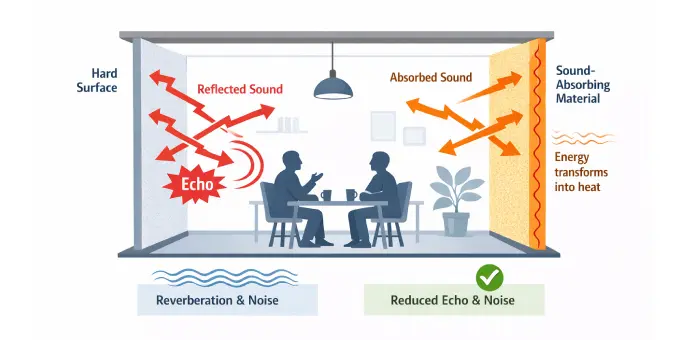
Sound absorption reduces the reflection of sound waves within a room. Absorptive materials capture sound energy and partially convert it into heat.
The main goal is to reduce echo, reverberation, and overall background noise.
If you hear a “ringing” reflection of voices from the walls in a meeting room, it usually means the space lacks sufficient sound absorption.
Common Sound-Absorbing Materials
Typical solutions include:
- acoustic panels made of mineral fiber
- porous materials (acoustic foam)
- textile panels
- ceiling baffles
- carpet flooring
These materials work inside a space, making sound softer and less reflective.
Where Sound Absorption Is Used
Sound absorption is commonly used in:
- open space offices
- meeting rooms
- studios
- restaurants
- conference halls
It is important to understand that sound absorption does not block sound transmission between rooms. Conversations can still be heard — they simply sound less sharp and less echoing.
What Is Sound Insulation?
If sound absorption works inside a space, sound insulation controls how noise travels between different areas of an office or between rooms.
How It Works
Sound insulation is a physical barrier that prevents sound from passing from one space to another.
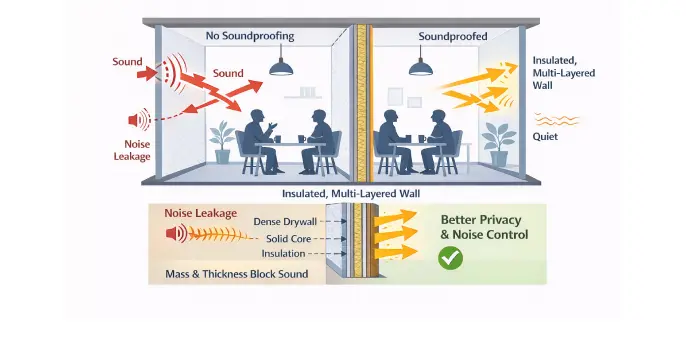
It is based on the mass–air–mass principle: the effectiveness of a structure depends on its mass, the presence of an air gap, and damping layers. Another important indicator is STC (Sound Transmission Class), which reflects how well a partition reduces airborne sound transmission. In general, the denser and heavier the construction, the better it blocks sound.
If you want conversations in a room not to be heard through the wall, you need sound insulation.
Common Soundproofing Materials
Typical sound insulation materials include:
- multi-layer drywall
- concrete
- brick
- mineral wool inside wall structures
- specialized acoustic membranes
Where Sound Insulation Is Used
Sound insulation is commonly applied in:
- private offices
- meeting rooms
- server rooms
- apartments
- medical facilities
Sound insulation blocks sound from escaping a space. However, it does not eliminate echo inside the room — that still requires sound absorption.
Key Difference: Comparing the Technologies
| Criteria | Sound Absorption | Sound Insulation |
|---|---|---|
| What happens to sound | Reduces reflections | Blocks sound transmission |
| Where it works | Inside a room | Between rooms |
| Eliminates echo | Yes | No |
| Blocks conversations | No | Yes |
| Requires major construction | No | Often yes |
| Suitable for open space | Partially | Limited |
This is where the main challenge of open-plan offices becomes clear:
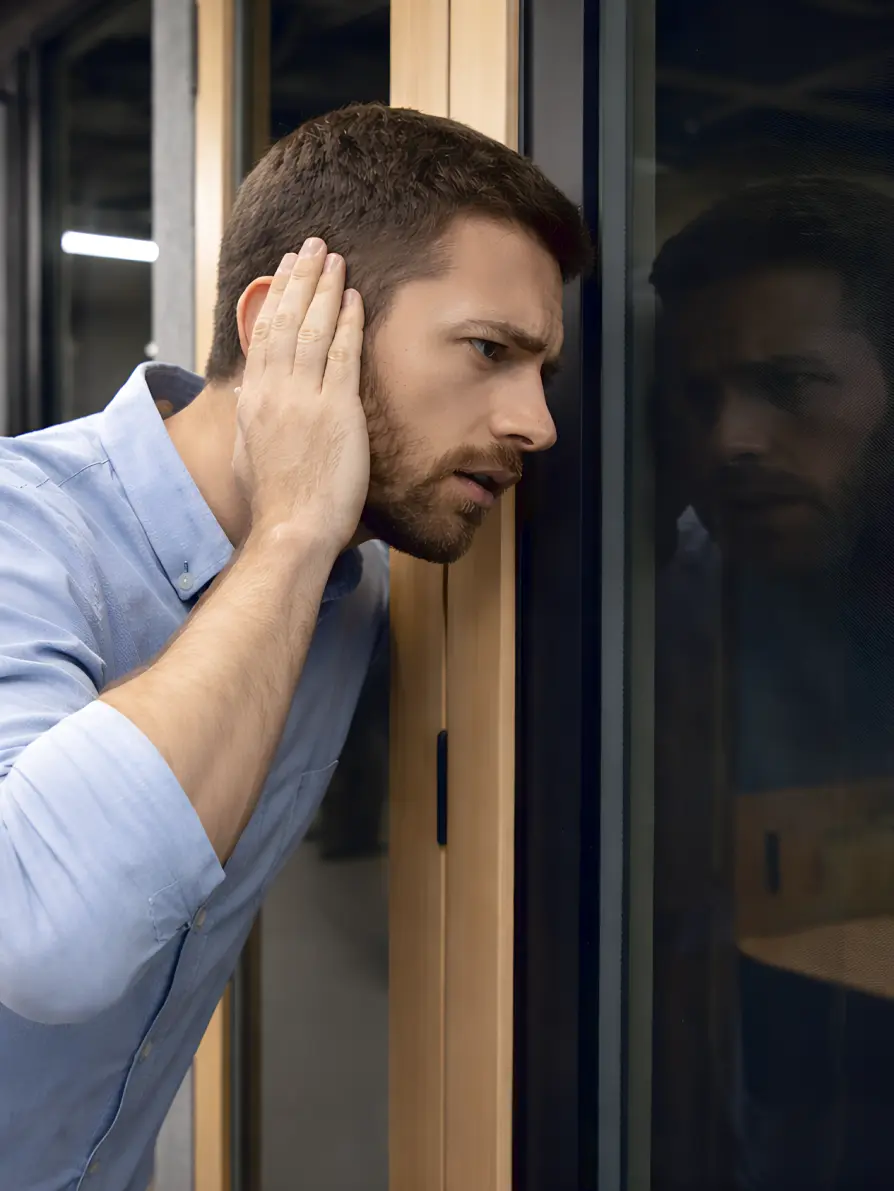
Acoustic panels can reduce overall noise and echo, but employees can still clearly hear each other’s conversations.
Why Open Space Offices Struggle With Noise
An open layout tends to amplify acoustic problems, due to:
- lack of physical barriers
- dozens of conversations happening simultaneously
- constant video calls
- no private zones
Even moderate background noise can reduce concentration. Human speech is one of the most distracting sounds because the brain automatically tries to interpret it.
As a result:
- productivity decreases
- irritation increases
- fatigue appears by the middle of the day
- the number of errors grows
Why Acoustic Panels Alone Are Not Enough
Many companies start by installing acoustic panels. This is logical — the solution is relatively simple and affordable.
However, the problem often remains for several reasons:
- Panels do not create privacy.
- Phone conversations are still audible to colleagues.
- Confidential meetings cannot be held.
- Full office soundproofing requires reconstruction.
This creates a need for a local solution — one that does not require renovation or major changes to the office layout.
How Acoustic Pods Solve the Problem
Acoustic pods are autonomous modules with a multi-layer panel construction (based on the mass–air–mass principle) and interior materials with a high sound absorption coefficient.
They combine sound absorption and sound insulation, typically reducing conversational noise transmission by about 25–35 dB, depending on the model and installation conditions.
Unlike acoustic panels or permanent partitions, a pod creates a localized quiet zone inside an open office.
WorkBooth Soundproof Pods — A Solution for Open Space Noise
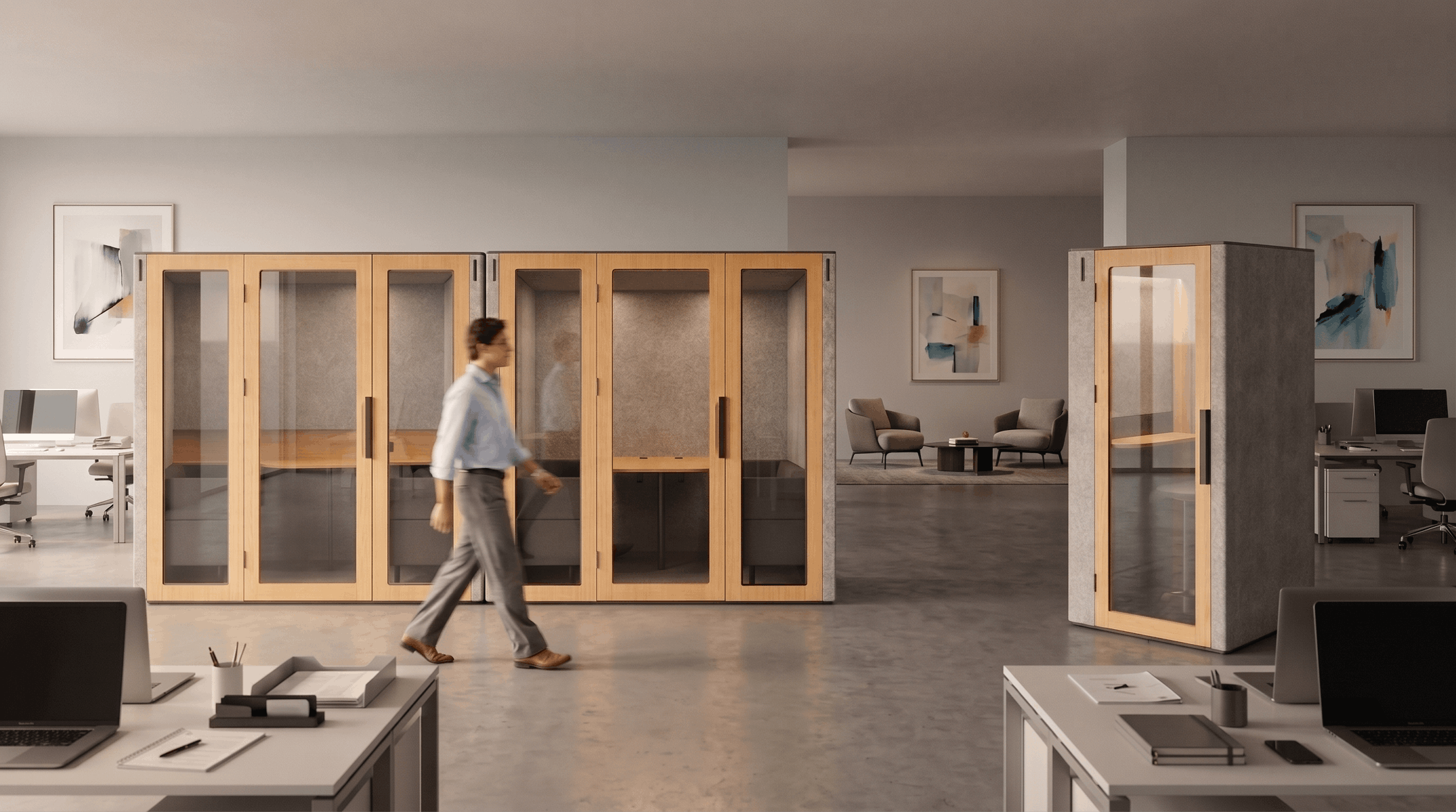
WorkBooth acoustic pods create a locally sound-isolated environment inside an open office, combining a physical sound barrier with internal sound absorption.
Each booth is built with multi-layer panels filled with dense insulation materials, while the interior acoustic finish reduces reverberation. A sealed door and sound-insulating glass limit how much speech escapes outside, while the built-in ventilation system keeps the space comfortable without opening the door during calls.
Inside the booth, sound does not reflect or “ring,” and outside the conversation becomes significantly less distinguishable. This combination makes the solution highly effective for open office environments.
The WorkBooth lineup allows companies to choose the format that best fits their needs:
- WorkBooth One — a compact single private booth designed for individual calls and video conferences. It provides a quiet, distraction-free space for employees who regularly need privacy during phone conversations or online meetings.
- WorkBooth Two — a comfortable 2-person office pod created for private conversations, interviews, and collaborative work. It’s ideal for short meetings, HR interviews, and online discussions where two people need a quiet, acoustically controlled environment.
- WorkBooth Four — a spacious 4-person meeting pod that works as a mini meeting room inside an open office. It creates a controlled acoustic environment for team discussions, brainstorming sessions, and small group meetings without the need to build a separate room.
Booths can also be equipped with a Logitech video conferencing module, expanding functionality for online meetings without affecting acoustic performance.
Even without additional equipment, the primary goal — noise reduction and privacy — is achieved through the acoustic design of the booth itself.
As a result, WorkBooth solves the key challenges of open space offices: phone calls, online meetings, HR interviews, confidential discussions, and tasks that require deep focus — all without major construction or office remodeling.
Customer Reviews on the Soundproofing Performance of WorkBooth Pods
Real-world experience from companies confirms that the acoustic performance of WorkBooth pods is noticeable in everyday work and significantly reduces noise distractions in open office environments.
“Clean design, great soundproofing, and excellent customer service. It’s a solid addition to our workspace that our team actually enjoys using every day.”
Ruby Delaney
“The booths provide excellent sound insulation, making them perfect for online meetings, phone calls, and focused work. Their modern and stylish design, combined with high-quality materials and craftsmanship, fully meets our expectations.”
“We are highly satisfied with our choice of WorkBooth and would recommend it to any company looking to enhance their office space and reduce noise distractions.”
Arkadz Yukhnevich
Why This Works Than Building Separate Rooms
- No major renovation required
- Installation takes minimal time
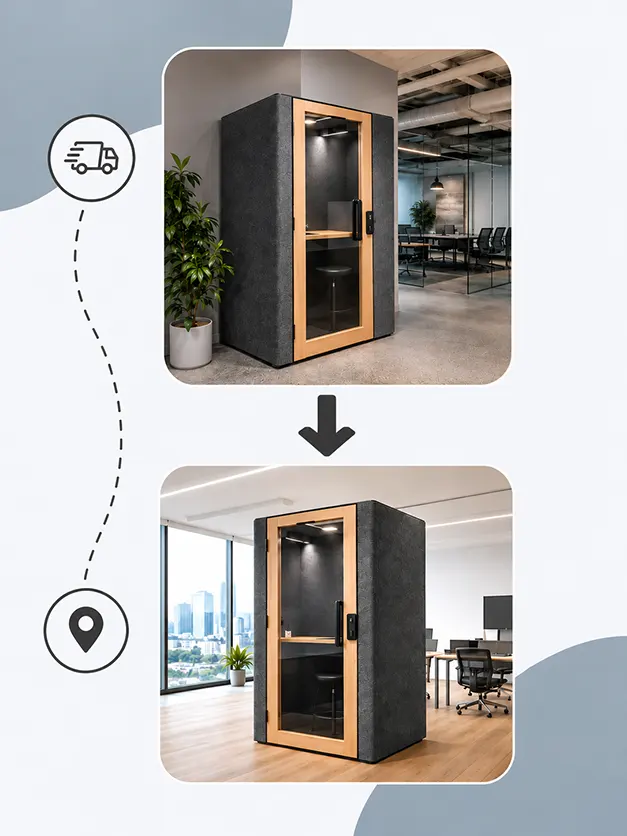
- Booths can be moved when the office layout changes
- Easy to scale as teams grow
This makes acoustic pods especially practical for hybrid offices and coworking spaces.
Who Acoustic Pods Are Especially Suitable For
- IT teams
- HR departments
- sales specialists
- coworking spaces
- companies with 10+ employees working in an open space
If dozens of calls happen in the office every day, the problem cannot be solved without localized soundproof zones.
Conclusion
Sound absorption and sound insulation are different tools designed for different purposes.
Sound absorption improves acoustic comfort by reducing reflections. Sound insulation blocks sound transmission between rooms.
However, in open space environments, neither solution alone can provide full privacy.
WorkBooth acoustic pods combine both principles: inside the booth they deliver effective sound absorption, eliminating echo and creating a comfortable environment for conversations and focused work, while externally they act as a sound-insulating barrier that reduces how speech spreads through the office.This is why more companies are choosing WorkBooth as a flexible and comprehensive solution for office noise. The pods address both sound insulation and sound absorption, creating a quiet and private space inside open offices — without reconstruction or complex approvals.
FAQ
Can an acoustic pod completely isolate sound?
It significantly reduces how much conversations can be heard outside the booth (depending on the model and installation conditions), providing privacy, but it does not create absolute silence.
How many decibels does a booth reduce?
The exact level depends on the model and construction, but modern solutions can noticeably reduce conversational noise.
Does installation require complex construction work?
Most models are delivered ready to assemble and can be installed without major construction.
Can the booth be moved?
Yes. If necessary, it can be dismantled and installed in another location..
Is this solution suitable for coworking spaces?
Yes, especially in environments where phone calls and online meetings happen frequently.